

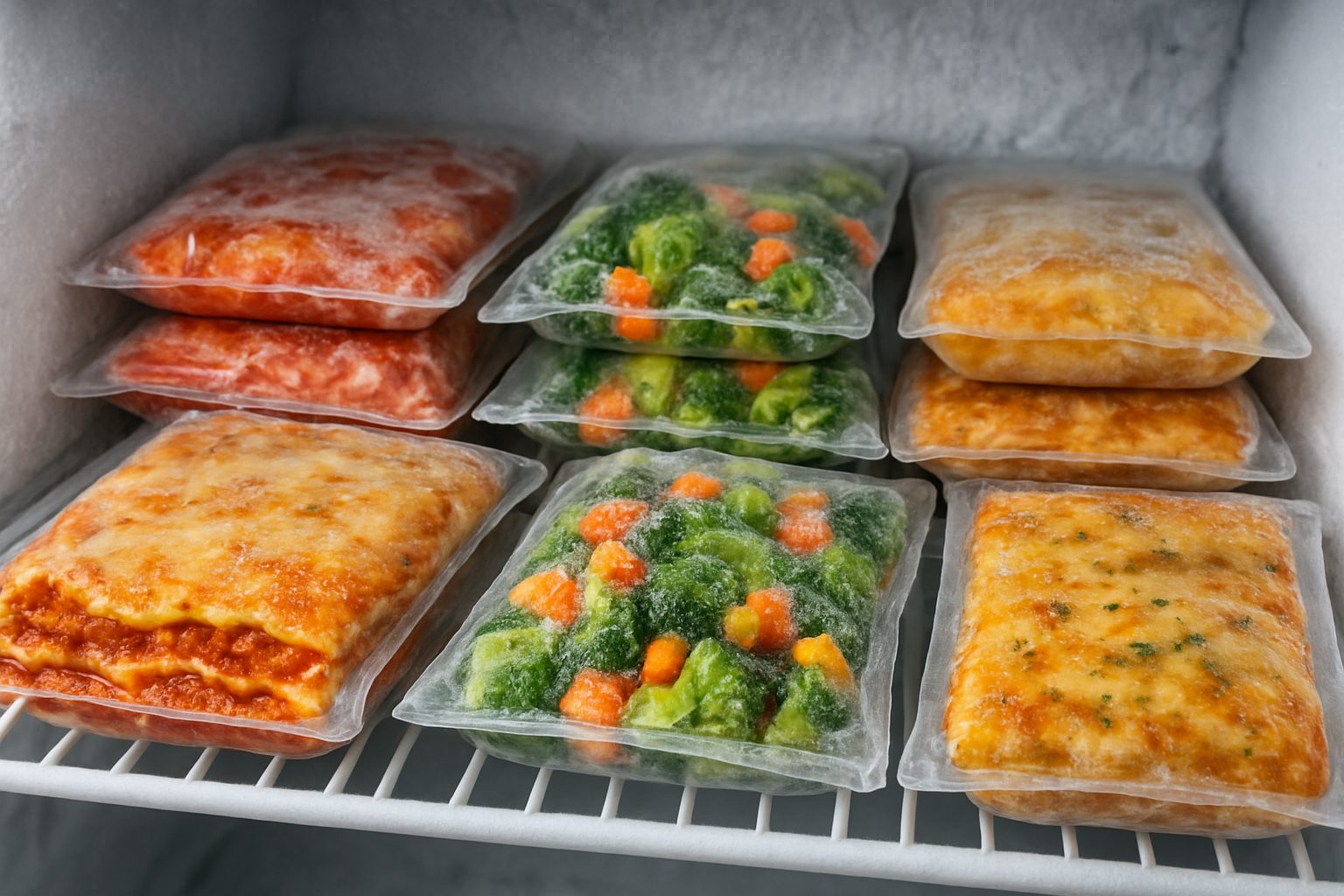
Keep the Food’s Identity When You Discard Its Package
If frozen food moves into another container, its identifying information needs to move with it. A handwritten “pierogies” label cannot replace the original filling description, ingredients and preparation directions. Before discarding a bag, arrange a clear connection between the food, its exact product name and the information someone else would need to prepare or choose it.
That connection matters most in a shared kitchen. The person who bought the food may remember which bag contained chicken and which contained cheese. A roommate opening the freezer later does not have that memory. Once similar-looking dumplings lose their packaging, visual guesses can become the household’s accidental labeling system.
Recognize what the printed bag tells you
Packaging does several jobs beyond making a product recognizable in the store. It identifies the variety, describes the contents and supplies instructions for the food in its purchased state. It can also carry information that is awkward to recreate accurately in a short note. Keeping the original bag is often the simplest approach if there is no practical reason to replace it.
The variety name matters because “potato filling” may leave out an ingredient that changes someone’s choice. Holy Perogy’s Fully Loaded Potato includes smoked pork bacon alongside potato, cheddar, onion, butter and sour cream. Another dumpling with potato and onion is not therefore equivalent. A note that preserves only the broadest ingredient can erase the very distinction a household member needs.
Size is also a poor substitute for identity. The brand’s mini choices include potato-and-cheddar Poppin’ Cheddar Bites and chicken-and-onion Cheeky Chicken Bites. They belong to different filling categories despite sharing a small format. A container marked “little ones” offers no useful answer to the person deciding which to eat.
The package is particularly important for preparation. These products are sold frozen and uncooked. Someone who sees a tidy container of dumplings should not have to guess whether the contents are raw, already prepared or leftovers. Keep uncooked products distinguishable from cooked food and follow the current directions for the particular product.
Ingredient and allergen information cannot be reduced safely to a household nickname. All eight varieties contain wheat, and the four cheese-containing varieties also contain milk. Those facts are a reason to retain the full current label, not a complete screening tool for every person with dietary requirements. Let the person concerned check the actual information relevant to them.
Keep the essential information with the container
Start by asking what problem repacking is solving. If a large outer container simply holds the original bags upright, you can retain the information without copying it. If the food must leave its bag, prepare its new identification before transferring anything. Working on one variety at a time is less confusing than opening several packages and labeling everything afterward.
A Cleveland household comparing similar names can use Holy Perogy’s fillings and retailers in Cleveland to see the difference between the brand’s chicken, pork-containing, vegetarian and plant-based descriptions. That overview helps with recognition, while the purchased package remains the reference for the exact food in your container.
A photo can preserve details that a small label cannot hold, but only if everyone can reliably find it. A picture buried among unrelated phone images is not much help to another cook. Give it an identifiable name or place it in a shared location, and write a reference on the container that leads to the correct product rather than a general folder.
Do not make the photo the only visible identification. The container should still state the full product name and plain filling description. A person opening the freezer ought to know whether they are looking at chicken-and-onion dumplings or potato-and-cheddar pierogies without first unlocking someone else’s phone. Detailed information can sit behind that immediate, readable label.
A retained section of packaging may be more straightforward than a digital system. Keep it clean, legible and connected to the correct food; avoid placing loose packaging fragments among the dumplings. If the method makes reading the directions difficult or separates them easily from the container, reconsider whether repacking is worth the inconvenience.
Make the system readable to everyone sharing the freezer
Ask a household member who did not buy the food to identify one container. Can they tell what it contains, whether it is uncooked and where the directions are? This is a practical check of the information itself. If you have to explain a color code or decode your own abbreviation, revise the label before relying on it.
Choose words over memory aids that only one person understands. “Blue lid” may work until the lid gets exchanged during washing. “Dad’s favorite” stops being meaningful when another similar food arrives. The product name and filling remain useful even when containers move, household routines change or a visitor helps prepare dinner.
Keep distinct products separate unless you have a deliberate, clearly identified reason to combine them. Mixing uncooked varieties into a single container can make it impossible to choose a specific filling later. It also leaves a future cook needing to reconcile directions from different packages. A small amount of saved space is not necessarily worth that ambiguity.
Do not relabel unidentified food by resemblance. If a package has already disappeared, an online picture cannot establish what is inside the container. A useful system prevents that loss of information; it does not justify inventing an answer after the fact. Treat uncertainty honestly and avoid offering an unverified description to someone with a specific restriction.
The moment to finish the job is while the original bag is still in your hand. Attach the identity, keep the instructions accessible, and check the connection once. Only then decide whether the empty packaging has truly finished its work.
Key Takeaways
- If frozen food is transferred to another container, its original identifying information must accompany it to avoid confusion.
- Packaging provides essential details such as variety, contents, and preparation instructions that cannot be accurately reproduced with a simple label.
- It is crucial to keep uncooked and cooked products distinctly labeled to avoid cooking mishaps and ensure correct preparation.
- Using a photo to retain details about a product is helpful, but it should not be the only form of identification visible on the container.
- Household members should be able to identify contents without needing specialized knowledge or memory aids to ensure clarity.
- Mixing different uncooked varieties in a single container can create ambiguity and hinder proper cooking directions.











Leave a Reply